Cracks that spread fast
We address linear cracking, block cracking, and edge cracking with the right prep, cleaning, and repair method to reduce water getting into the pavement structure.
Serving Dallas, Texas & surrounding areas
Asphalt Repair in Dallas, Texas
Fix cracks, potholes, and failing patches before they spread. Sealcoating Dallas delivers durable repairs for parking lots, drive lanes, and private drives with clear scopes and scheduling that fits your property.
Local Pavement Conditions
If you searched for asphalt repair Dallas, you are probably dealing with cracking, raveling edges, ponding water, or potholes that keep coming back. In Dallas, surfaces take a beating from heavy traffic, intense summer heat, and sudden rain that pushes water into small openings. The result is simple: minor damage turns into base failure if it is ignored.
Sealcoating Dallas handles asphalt repairs for commercial and residential surfaces across Dallas, TX, with work that is sized to the problem. Some sites need targeted crack filling and spot patching. Others need saw-cut and remove, base repair, and a full-depth patch so the repair ties back into stable pavement. The goal is the same either way: restore a smooth surface, stop water intrusion, and keep the repair from unraveling at the edges.
Our shop is based at 1100 S Akard St, Suite 4, Dallas, TX 75215, so we are set up for quick dispatch to properties around Downtown Dallas, I-30, I-35E, and the neighborhoods that feed into those corridors.
Damage We Address
We address linear cracking, block cracking, and edge cracking with the right prep, cleaning, and repair method to reduce water getting into the pavement structure.
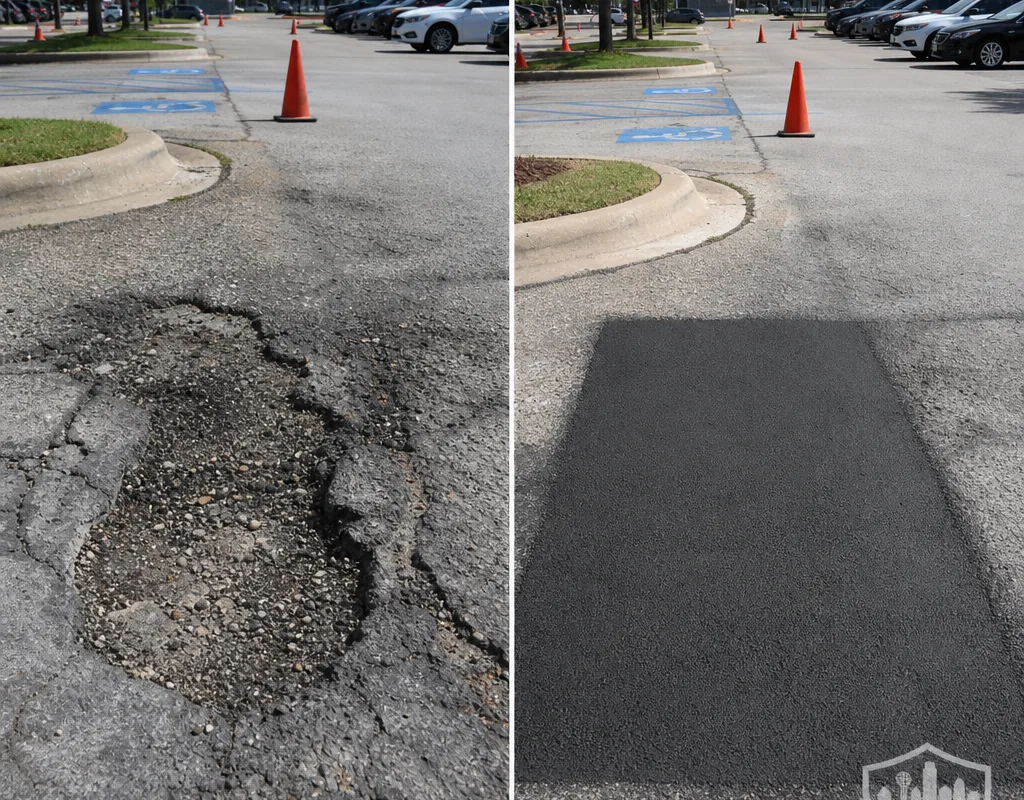
If a pothole is forming, the surrounding asphalt is usually compromised. We cut to sound pavement, repair the base when needed, and compact in lifts for a longer-lasting patch.
When the surface starts shedding aggregate, traffic wears the area down quickly. Spot repairs can restore the driving surface and reduce further unraveling.
Depressions at entrances, utility cuts, or old repairs can create liability issues. We repair the area to improve smoothness and drainage.
Standing water accelerates pavement failure. We look for low spots, clogged drain paths, and edge issues that keep water on the asphalt.
Preparation and Repair Depth
A lasting asphalt repair starts with identifying why the area failed. If the surface is intact and the issue is small openings, crack sealing or localized surface repair may be enough. If the asphalt is soft, pumping fines, or breaking apart under traffic, the base is often involved and the repair needs to go deeper.
For Dallas asphalt, we commonly use repair approaches like:
We also pay attention to joints and edges. Straight, clean cuts, proper tack coat at vertical faces, and tight compaction are what keep water from getting between the old pavement and the new patch.
If your long-term plan includes protecting the surface after repairs, many owners pair patching with asphalt sealcoating in Dallas once the pavement condition supports it.
From Inspection to Reopening
We review the distressed areas, traffic flow, and drainage patterns, then define what will be repaired and what will be left as-is so expectations are clear.
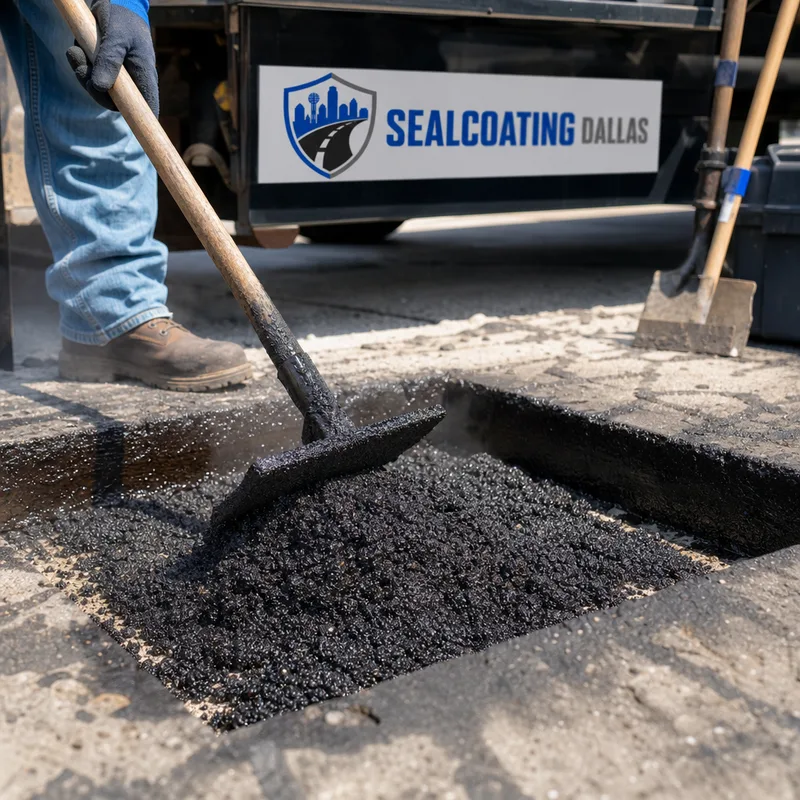
We mark limits, set safety controls, clean the area, and remove failed material. For structural failures, we cut to stable pavement instead of feathering broken edges.
If the sub-base is wet, loose, or undermined, we correct it before new asphalt goes down. Skipping this step is a common reason potholes return.
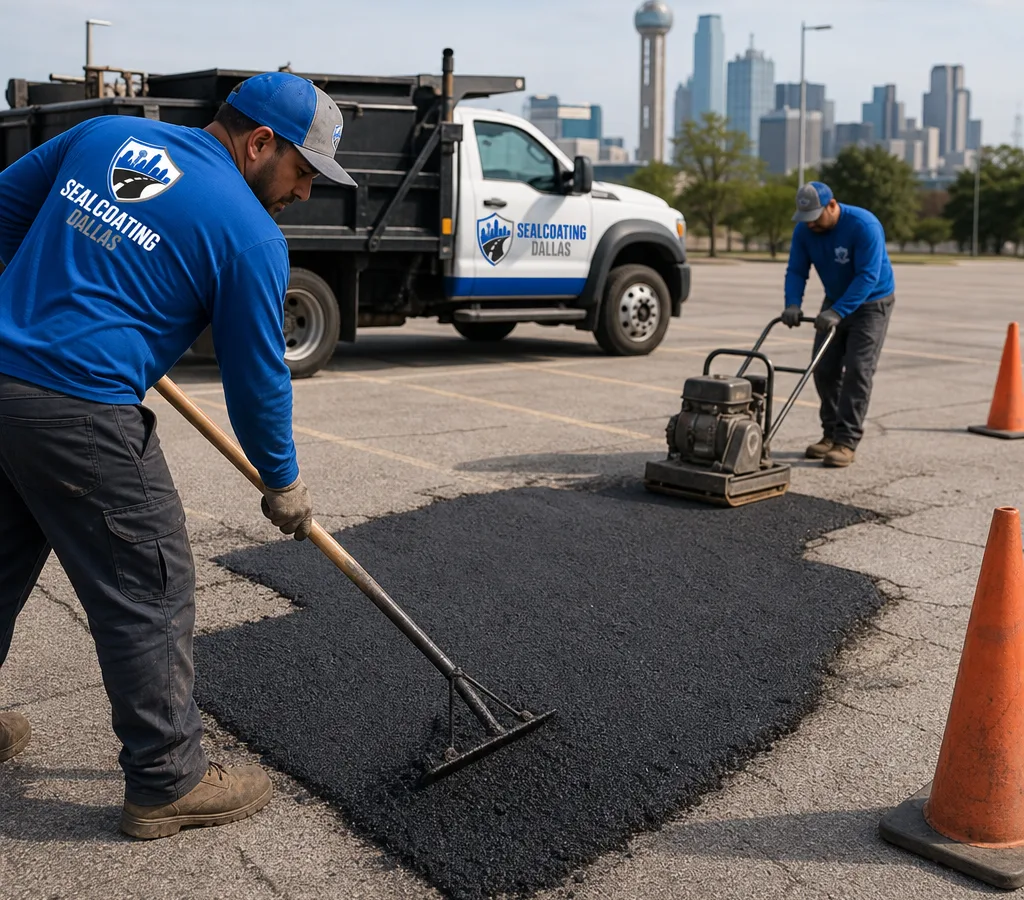
We place asphalt in appropriate lifts, compact properly, and form clean transitions to surrounding pavement to reduce future edge breakdown.
We confirm surface smoothness, joints, and any areas that could hold water, then coordinate reopening timing based on the mix and site conditions.
Pricing and Scope
Most asphalt repair in Dallas typically ranges from about $450 to $2,500+ depending on the size and whether the base needs correction. A small pothole or isolated patch is often $450 to $900, while multiple full-depth patches across a drive lane or parking lot can run $1,200 to $2,500+.
Final pricing depends on square footage and depth, saw-cutting vs. surface repair, base material needs, access for equipment, disposal, and how traffic control must be staged. The exact cost is confirmed after an on-site evaluation and a written scope.
Repair Planning and Access
Many asphalt repairs can be scheduled quickly when access is straightforward and materials are available, but timing depends on weather, the size of the repair, and whether we need to stage work around tenant or customer traffic. For occupied properties near Downtown Dallas and the Design District where traffic stays steady, we often recommend off-peak windows to keep access open while still getting enough uninterrupted time for removal and compaction.
If the pothole is shallow and the surrounding pavement is stable, a targeted patch may be appropriate, but repeat failures usually mean the area needs to be cut out to sound pavement and repaired full-depth. In practice, if edges are crumbling, the asphalt feels soft, or the hole keeps reopening after rain, full-depth patching with base correction is usually the longer-lasting choice.
Rapid failure usually comes from water getting into cracks and joints, combined with traffic loads that flex the pavement and break down weak spots. Heat also matters: hot summers soften asphalt and make rutting and shove more likely in areas like entrances, turns, and dumpster pads where loads are high and vehicles move slowly.
Most asphalt repair needs a reasonably dry work area because moisture interferes with bonding and can weaken the base. Light, short breaks in weather can work for small repairs if the surface and base are dry enough, but for reliable results we schedule around rain so the patch can be installed and compacted correctly.
Many hot-mix patches can reopen to traffic the same day once compaction is complete and the material has cooled enough for the site conditions. The exact timing depends on the repair thickness, air temperature, and traffic type; heavy trucks or tight turning movements may require a longer cool-down window.
Yes. We repair residential driveways and private drives as well as commercial lots, drive lanes, and entrances. The repair approach changes based on traffic load and turning movements, which is why a driveway patch and a shopping center drive aisle patch may be scoped differently even if they look similar on the surface.
Inspect the Damage Before It Spreads
Share what you are seeing on the surface and when the area needs to stay accessible. We will confirm the best repair method for your asphalt in Dallas and provide a written scope with straightforward pricing.